At 2:00 a.m., Ms. Lim would pull a blanket over her head in North Korea and turn the radio dial low enough that no one else in the house could hear. It was the only way to listen without being caught. “I heard the Gospel for the first time through FEBC,” she said. That single act, hidden under a blanket in the middle of the night, planted a faith that later spread to her entire family.
More than 80 years after FEBC launched, stories like Ms. Lim’s are why the radio remains one of our most trusted tools for sharing the Gospel with the world.
A Signal That’s Hard to Silence
In places hostile to the Gospel, radio offers something the internet cannot: privacy without a trace. In North Korea, AM broadcasts are far harder to detect and block than internet activity, allowing the Gospel to reach listeners without exposing them to the regime.
In Pakistan, where evangelism carries real legal and social risk, broadcasts let believers encounter Scripture in the privacy of their own homes rather than in a public, traceable space.
In the mountains of Mindanao, Philippines, terrain has always been a barrier to personal connection. Some communities are hours from the nearest town, with little access to churches or basic infrastructure, let alone the internet. For more than 30 years, Pastor Mar has used radio to close that distance, broadcasting Scripture to the Matigsalug, Manobo, and Bisaya people. During the pandemic, he distributed two-way radios so families could respond in real time. “Praise God, I can hear Scripture,” listeners would say back to him, sometimes with entire households gathered around a single set.
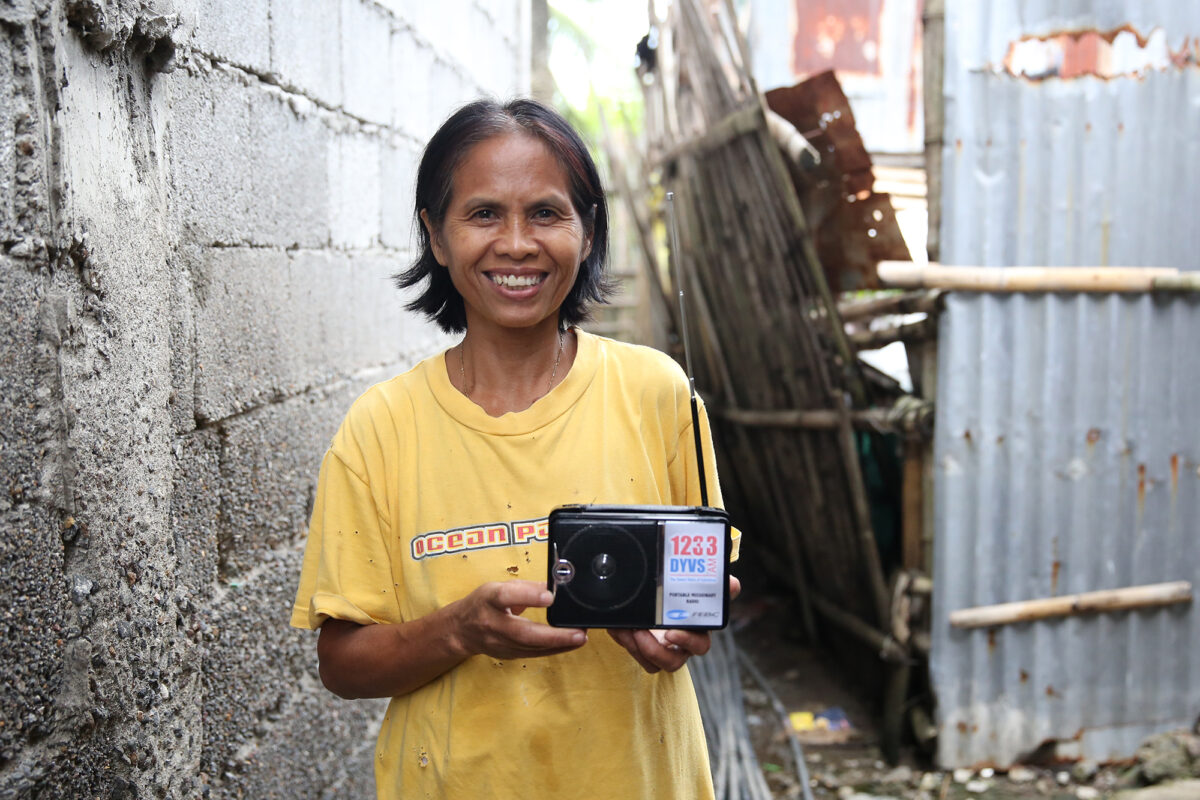
These stories reveal the heart of why we still broadcast through radio. The low-cost tool requires little infrastructure or investment. It also benefits more than the individual. Our data shows that when we gift a radio to one person, it is then shared with an average of 30 community members. By gifting people with a wind-up, solar, or battery-powered radio, their entire community can hear the Gospel in their heart language.
Staying Personal as We Grow
Radio has always let FEBC do something both large and intimate at the same time: reach millions of people while remaining one trusted voice. All 260 FEBC stations are hosted by local believers, broadcasting in listeners’ own languages and cultures. We now broadcast in 152 heart languages, from Hmong to Ukrainian to Kyrgyz. For many listeners, the host they hear each day is the first Christian they’ve ever encountered.
That personal connection doesn’t end when the broadcast does. In Cambodia, FEBC teams distributed 1,300 radios and made more than 3,500 in-person visits last year alone. In Ukraine, program director Igor and his team built a lamp with a built-in MP3 player so families huddled in bomb shelters could still hear Scripture when the power went out.
Committed to the Radio, While Embracing New Technology
FEBC started with one radio station in 1946 because it was the best available innovation for the Great Commission. Since then, we’ve added social media, podcasts, and other digital solutions as effective ways to reach more people, faster. For example, FEBC China now runs a mobile app for discipleship. FEBC Cambodia reaches many through Facebook and YouTube. FEBC Ukraine broadcasts from cellphones when the station loses power. Teams across the world are committed to embracing the best available technology, so they can reach their neighbors in ways that work best for their culture and circumstances.
Even as our solutions and tools multiply, radio often remains one of the most effective ways to serve the hard-to-reach person: the listener hiding under a blanket at 2:00 a.m., the family in a mountain village with no internet signal, the child in a bomb shelter with nothing but a lamp. As long as there are people in need of hope and new life, FEBC will continue to use the best means to reach people right where they are. In many cases today, that’s still the radio.
Because of your partnership and support, FEBC is able to continue sharing the Gospel with people who are desperate for hope – Thank you!
